

La p谩gina que intenta visitar s贸lo est谩 disponible en ingl茅s. 隆Disculpa!
The page you are about to visit is currently only available in English. Sorry!

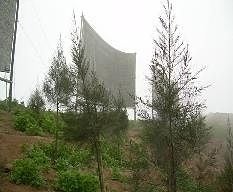 In the community of Bellavista, outside of Lima, there鈥檚 a lot of fog, but very little water. The shantytown relies on trucked-in water for everything from bathing to cooking to irrigation. When deliveries run late鈥攚hich apparently is quite often鈥攔esidents are stuck without the precious resource. Or they were, until biologists from the German NGO figured out how to capture water from the fog that鈥檚 abundant except during the summer. (photo: Alimon)
Reuters on how the three-year-ol scheme works:
Using nets similar to those used in volleyball, residents condense fog, drip-by-drip, into drainage pipes running down the hill into tanks that store hundreds of liters of water for irrigation, bathing and cooking.
"Pure water from fog, can you believe it?" Noe Neira, Bellavista's community leader said, as he dipped his hand into a brick tank filled to the rim. "There was so much water in the air and we didn't know how take advantage of it."
While additional nets could supply water to more shantytowns, currently there鈥檚 no plan to expand the project, Reuters reports. In Lima, residents have tap water, which costs about one-tenth as much as trucked water.
Communities the world over suffer from drinking water shortages. Some 1.2 billion people鈥攏early one-fifth of the global population鈥攍ive in areas of scarce supply, the .
The need for more drinking water is driving innovation. Architects at the Polish firm have dreamed up a couple of buildings worth a closer look, though they鈥檙e still in blueprint form.

Conflict-plagued Darfur has been ravaged by drought, but in 2007 scientists lies beneath the region. That鈥檚 where the Watertower comes in. H3AR鈥檚 skyscraper would pull water from the aquifer, and in addition to storing water, serve other purposes: hospital, school, food storage center, . Pumps would remove water from the aquifer, propel through the building to heat/cool it, and store the blue gold in the structure鈥檚 core. Any wastewater would be recycled on site.
Here鈥檚 an idea for taking water collection to a whole new level. Architectural students at H3AR have also entered a proposed rainwater-collecting skyscraper in the 2010Skyscraper Competition, .
 Dubbed the 鈥淐apture the Rain,鈥� the skyscraper received a special mention at the competition and harvests rainwater to meet with the daily water needs of its residents. The structure has an innovative roof to capture the maximum amount of rainwater. Water reservoirs located just below the roof鈥檚 surface in the form of a large funnel and reed fields serve as a hydro botanic water treatment unit, which processes water into usable water that is further transmitted to apartments.
Interested in building your own rainwater collector? Click for easy-to-follow instructions.