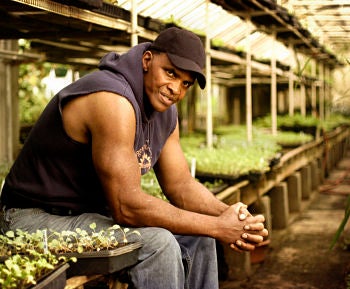
Will Allen. Credit: Growing Power
If I were a cow, I鈥檇 want to live on Joel Salatin鈥檚 sustainable farm in Virginia. A worm? Give me farmer-activist Will Allen鈥檚 rich soil in Wisconsin any day. Of course, it would help to see their operations to understand my convictions. Short of traveling there, you can watch (Ripple Effect Productions, 2009) a new film that champions a few who are re-inventing our food system from one based on industrial agriculture to one rooted in, well, the earth.
Take Joel Salatin. His 400-acre is a self-sustaining organic operation, which essentially means that it鈥檚 not reliant on unnatural chemicals鈥攊.e., pesticides, fertilizers, hormones. Instead, Salatin rotates his land, allowing cattle to graze on patches of grass that regenerate once the herd moves on. In its wake, chickens arrive to peck at fly larvae in the manure left behind, thereby 鈥渟anitizing鈥� the fields as the remaining dung works its fertilizing magic.
Salatin鈥檚 property is a bucolic daydream. We arrive at dawn, the sun鈥檚 rays alighting on dewdrops while birds sing as if in praise of another day in paradise. Joel takes us on a tour of the property, explaining his methods. 鈥淧art of what we have to do as stewards of the earth is respect the design of nature,鈥� he says in a slight southern drawl that鈥檚 as welcoming and authentic as the lush land around him. At the end, we鈥檙e invited to peer in on a family dinner outside, where the diners plunge into succulent homegrown fare that had me salivating at each bite. In retrospect, that leftover Vietnamese food I ate for dinner was probably more appropriate for compost than consumption.
Like Salatin, Will Allen also runs an organic production鈥攁lbeit a much smaller one in an urban setting in Milwaukee, Wisconsin. Called , it serves as an educational farm where Allen鈥攁 former basketball player whose statuesque height and giant biceps serve him well for his current role as Jolly Green Giant鈥攔ecommends to his visitors of all ages to 鈥済raze as you go; everything is edible here.鈥� He makes the most of his three-acre space, growing vertically with hanging plants. With no room for ungulate herds to spread fertilizer, he instead relies on tilapia. Yes, fish. Like a river would, the water from their tanks hydrates Allen鈥檚 plants, and the fishy 鈥渂iosolids鈥� nourish them. Again, we viewers yearningly look on as Allen and company feast on fare that millions of Americans are hard-pressed to find in their nearby supermarket.
That is, unless their supermarket is like David Ball鈥檚 Kansas City stores, which sell food stuffs from , a cooperative of at least 75 family farms in the surrounding region that Bell helped organize. His is an exemplary model of a how the convenience of a grocery store doesn鈥檛 have to come at the expense of quality.
What I like about director Ana Sofia Joanes鈥檚 72-minute documentary is that it concentrates more on solutions to fixing our food system than its problems. The bad news is there鈥攂ut thankfully Joanes serves it at the beginning, with food-knowledgeable guests such as author Michael Pollen sounding off on monocrops, processed foods, and nutrient overload. The rest of the film is a several-course meal of hope designed to give those hungry for change a few ideas to chew on.
Fresh's New York Green Carpet premiere screening is this Wednesday, April 7th. It's part of Whole Foods Markets' national film series, "," which I blogged about last week. Find local listings for Fresh, and register for Fresh-related events (like dinners!) .


