

La p谩gina que intenta visitar s贸lo est谩 disponible en ingl茅s. 隆Disculpa!
The page you are about to visit is currently only available in English. Sorry!

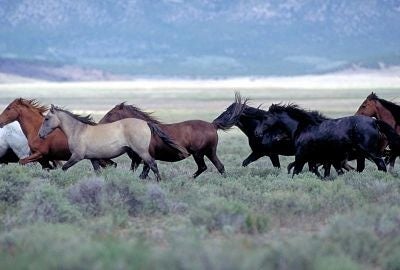 Onaqui herd near Dugway, Utah. Courtesy BLM
If your Internet-savvy kids have been begging for a pony, you might want to block the Bureau of Land Management鈥檚 website. The agency, which is responsible for wild horses and burros, is holding an beginning March 10. The animals up for bid go for a minimum $125 per horse ($250 for mare-foal pairs), and they鈥檙e currently living in the agency鈥檚 holding pens.
Big name celebs like singer Sheryl Crow e adopted mustangs. But Ms. Crow has joined a number of horse advocates in t against Interior Secretary Ken Salazar鈥檚 controversial new plan to try and decrease free-ranging wild horse populations. Essentially, the scheme calls for large-scale roundups. Despite protests, federal officers rounded up 2,500 wild horses in December; in February, land managers another roundup of 600 more until after foaling season.
The conflict is set to come to a head on April 30, the Reno Gazette Journal . On that day, "a federal court will hear arguments from wild-horse advocates that the Interior Department and Bureau of Land Management are violating the 1971 Wild Free-Roaming Horses and Burros Act by rounding up horses and putting them in expensive holding facilities."
Alexa Schirtzinger reports on the issue, including the plan's inclusion of aggressive fertility control and managing sex ratios in free-roaming herds, in the of 探花精选:
On December 28, despite widespread protests and an unsuccessful lawsuit, the federal government launched a roundup of 2,500 wild horses in an attempt to keep the iconic animals鈥� numbers in check. Using helicopters, Bureau of Land Management (BLM) officials forced mustangs in Nevada into holding pens before putting them up for adoption or sending them to long-term federal corrals. While the agency has removed horses a few hundred at a time for decades, this latest move was part of an aggressive new strategy Interior Secretary Ken Salazar announced in October 2009 to ramp up roundups and relocate two-thirds of the estimated 37,000 free-ranging horses in the West to newly constructed pens in the Midwest and East.
The BLM insists the approach is essential for managing feral herds, which can double their population in just four years. The creatures can wreak ecological havoc, stripping habitat of vegetation that other species, like sage grouse and pronghorn antelope, rely on, and exposing themselves to mass starvation (see 鈥溾��). Furthermore, demand for mustang adoption has plummeted鈥攆rom 5,700 in 2005 to fewer than 3,500 last year鈥攃reating a glut of 34,000 horses in BLM holding pens. 鈥淚t鈥檚 mythology that horses will maintain their populations on their own,鈥� says Brian Rutledge, director of 探花精选 Wyoming. 鈥淚n that process we lose all the other sagebrush denizens.鈥�
The proposed policy, which will cost $64 million and requires Congressional approval, has enraged some activists. Chasing horses with helicopters is 鈥済overnment-sponsored cruelty,鈥� says Ginger Kathrens, head of horse advocacy group Cloud Foundation, who thinks the proposed 鈥淪ala-zoos鈥� just constitute more costly pens for the free-ranging animals.
BLM spokesman Tom Gorey says the 鈥渕ore salient鈥� aspect of Salazar鈥檚 plan involves addressing population growth rates at their source. By removing thousands of horses now, says Gorey, ultimately the agency won鈥檛 have to add to holding pens and will round up only as many mustangs as can be adopted. Financially, that鈥檚 crucial: Holding costs took up 70 percent of the $40.6 million BLM wild horse program budget last year.
To continue reading the story, click .