

La p谩gina que intenta visitar s贸lo est谩 disponible en ingl茅s. 隆Disculpa!
The page you are about to visit is currently only available in English. Sorry!

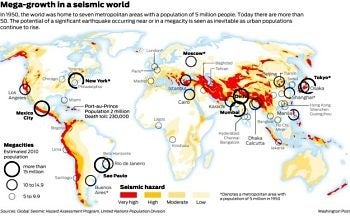
Graphic from the Washington Post
The last week killed at least 700 people and displaced 2 million. A prediction of the event would鈥檝e been invaluable, but while seismologists know where earthquakes are likely to occur, they can鈥檛 pinpoint exactly when and where they鈥檒l happen.
"We don鈥檛 have any good way to predict earthquakes,鈥� Jim Dieterich, a geophysicist at the University of California, Riverside and chair of the USGS National Earthquake Prediction Evaluation Council, told me after the 2008 earthquake in China鈥檚 Sichuan province. 鈥淚n terms of short-term warning鈥攆rom a few days or weeks鈥攚ith high reliability, we鈥檙e just not there at this point."
There have been some successful predictions. Perhaps the most famous was in 1975, when, in response to fluctuating groundwater levels and bizarre animal behavior, Chinese officials evacuated a town hours before a 7.3-magnitude quake hit. Still, most scientists chalk that prediction, and others, up to luck.
Here鈥檚 more on the subject from an article in Plenty:
Instead of trying to predict earthquakes, in recent years geologists have turned their attention to forecasting them. Similar to a weather forecaster estimating a 40 percent chance of rain, scientists assess geological conditions and calculate the probabilities that quakes of certain sizes will occur during specific time periods in a given area. For example, a 2008 USGS study found that the chance of one or more 6.7 magnitude earthquakes hitting California in the next 30 years is greater than 99 percent. The information might not be helpful for, say, evacuating a city, but it can help shape emergency planning and other measures.
When an earthquake occurs, a fault, or crack in the Earth鈥檚 crust, ruptures, radiating seismic waves, like ripples from a stone tossed into a lake, causing damage as they pass through the ground.
Scientists develop forecasts by monitoring the motion of faults and gathering information on past earthquakes to figure out how regularly major ones take place.
But it鈥檚 not an exact science. Given the history of California鈥檚 Southern San Andreas Fault, you鈥檇 expect a major earthquake every 100 years, says Mary Lou Zoback, a geophysicist and vice president of earthquake risk applications at Risk Management Solutions, a company that specializes in catastrophe models for the insurance industry. 鈥淚t鈥檚 been 300 years since the last big one there, so we give it a really high likelihood of going in the next 30 years."
Zoback was part of a team that monitored a segment of the San Andreas Fault near Parkfield, in central California, which seemed likely to rupture. Earlier in the century, quakes of about a 6.0 magnitude had occurred regularly, and researchers set up instruments to capture any activity before the next earthquake, which they expected to hit in the late 1980s. The quake didn鈥檛 happen until 2004, but all of the equipment was still in place to record the event.
鈥淲e had so many instruments, and there was not a single precursor. It just wasn鈥檛 there,鈥� says Zoback. 鈥淚t was really the nail in the coffin for deterministic predictions."
Still, one kind of prediction is possible鈥攊t involves a time scale of seconds. Because seismic waves propagate at a couple of miles per second, if a city is 100 miles away from a big fault, sensors could pick up the movement and give a 10-second warning. Japan鈥檚 early warning system stops trains, and may give people a few seconds to clear out of elevators and take cover.
鈥淐alifornia is another candidate for a system like that,鈥� says Bruce Shaw, a physicist at Columbia University鈥檚 Lamont-Doherty Earth Observatory. 鈥淚t鈥檚 not like we could never have any warning, it just might not be the warning that people have in mind."
And scientists haven鈥檛 given up on short-term forecasts. When it comes to aftershocks鈥攕maller earthquakes triggered by a major quake鈥擴SGS has devised a 24-hour forecast map for California. And some researchers are working to build models that deal in months, instead of decades.
Testing these systems is challenging because few large earthquakes occur, compared to small quakes. Also, models are often criticized because they can be tweaked to make them appear more accurate than they are. But a new project may help change that. Last September, the Southern California Earthquake Center launched the , an international collaboration that will set standards for forecasting experiments, conduct experiments around the world, and evaluate the findings.
鈥淚t鈥檚 really exciting,鈥� says Zoback. 鈥淚ndependent scientists who have no stake in the models will run them. For the first time, we can have objective tests, though it may take five to ten years before we see any results."
Read the rest of the article .
To report an earthquake, or see where tremors have occurred most recently, visit the .