

La p谩gina que intenta visitar s贸lo est谩 disponible en ingl茅s. 隆Disculpa!
The page you are about to visit is currently only available in English. Sorry!

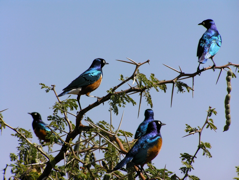 Despite what you learned in science class, it turns out female birds aren鈥檛 always drab in comparison to males. Sure, the peacock displays gorgeous plumage, while the peahen鈥檚 earthy tones are less likely to dazzle the human observer. But consider the superb starling of East Africa: males and females are both highly ornamented and have similar wing size.
The reason for the females鈥� finery is likely competition to be the egg layer; superb starlings live in large family groups, where everal adults tend to the chicks of a single mother. So in a group where not all individuals breed, the flashiest female is likeliest to get lucky, Dustin Rubenstein of Columbia University and Irby Lovette of Cornell Laboratory of Ornithology report in .
鈥淚f competition for reproductive opportunities is intense in both sexes in species that live in family groups,鈥� says Rubenstein, an assistant professor of ecology, evolution and environmental biology, 鈥渋t stands to reason that the traits that are typically only elaborate in males might also be elaborate in females in cooperatively breeding species.鈥�
To find out, the researchers looked at the 45 species of African starlings. Some of the species employ the family group approach to tending nests and some raise their chicks solo. In addition, in some species males and females look the same, but in others, they look quite different.
Rubenstein and Lovette found that in more than 80 percent of cooperative breeders鈥攖he ones that live in family groups鈥攆emales resembled males; the same was true for only about 30 percent of non-cooperative breeders.
鈥淭his goes beyond starlings,鈥� says Rubenstein. 鈥淎ny species that lives with relatives might be expected to show similar patterns. This type of complex social behavior is not only common in birds, but also many mammals鈥攊ncluding humans鈥攁nd insects.鈥�
[Superb startling social groups can contain as many as 30 individuals, and the helper relationships among group members are extremely complex. Males and females are both highly ornamented. Photo: Dustin Rubenstein]