

La p谩gina que intenta visitar s贸lo est谩 disponible en ingl茅s. 隆Disculpa!
The page you are about to visit is currently only available in English. Sorry!

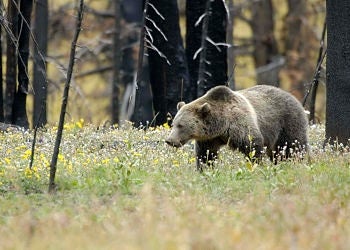
Grizzly bear in Yellowstone. Courtesy U.S. Fish and Wildlife Service
I used bear spray for the first time last summer. Ok, that鈥檚 not quite accurate鈥擨 accidently let loose the contents of a bear spray canister in August. It wasn鈥檛 in the wild, it was in my parents鈥� driveway. After a glorious four-day backpacking trip in Montana鈥檚 Flathead National Forest鈥攄uring which I saw fields filled with bear grass and hillsides bursting with huckleberries, but no bears鈥擨 was unpacking and the bear spray can popped out of my backpack, hit the ground, and started spewing its rust-colored contents on the driveway. I backed away slowly, keeping an eye on the spray (I don鈥檛 know, maybe I thought I should treat the wild canister the same way I鈥檇 taught to handle a bear encounter). It was still going a few minutes later, so I put on some gloves, wrestled the can inside a garbage bag, and tossed it in the Dumpster. Which, it turns out, is the wrong way to dispose of bear spray. It should be treated as hazardous waste.
Outdoor enthusiasts are often encouraged to take bear spray into the backcountry. On its 鈥淏ears鈥� page, Glacier National Park, 鈥淚f you cannot escape or if the bear follows, use bear spray, or shout and try to intimidate the bear with a branch or rock. Do whatever it takes to let the bear know you are not easy prey.鈥� The text goes on to explain the proper use of bear spray, and warns that 鈥淯nder no circumstances should bear spray create a false sense of security or serve as a substitute for standard safety precautions in bear country.鈥�
Such safety measures add up to a lot of cans. Yellowstone officials, for instance, estimate that 2,000 bear spray canisters improperly discarded in the Park each year ultimately end up in the landfill. Some parks have collection bins, but proper disposal is still a problem.
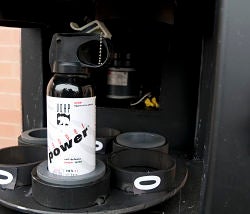 Students at Montana State University may have come up with a solution. They built a machine (right) that removes the chemical that burns bears鈥� eyes and mucus membranes, as well as the refrigerant that shoots the chemical out of the canister. The machine also crushes the cans, which can then be recycled normally with other metals. The entire process takes about 30 seconds.
The Forest Service funded the project, and representatives from that agency and others gathered to watch a demonstration of the machine recently in Bozeman, Montana.
"This has been a dream of mine for many years," Jim Evanoff, environmental protection specialist for Yellowstone National Park, told the MSU News Service.
More from the :
The park had 3.3 million visitors in 2009, with many of them carrying bear spray while in the park, Evanoff said. Some visitors turned the canisters in at visitor centers or the park gates when they left. Others threw the canisters into Dumpsters, which can create problems later. Every piece of garbage in the park ends up in a composting facility just outside of West Yellowstone. If a fork lift or backhoe accidentally runs over the canisters, the building has to be evacuated for several hours while the bear spray dissipates.
"It's just a huge issue in this ecosystem," Evanoff said.
Yellowstone is taking action. The Park is currently to design, build, and deliver a mobile bear spray can recycling unit by August 1, 2010.
To find out how to properly dispose of bear spray, call your city or county waste management department. Don't make the ecosytem bear the brunt of the waste.